Peace & Security Data for the AI Era.
Living Signals is a peace and security data company. Our daily data keeps humanitarian agencies and researchers up to date with what is changing on the ground, and it is built to do the same for insurers, lenders and security teams.

- Countries
- 48
- Languages
- 25+
- Active news sources
- 2,200+
- Extracted claims
- 490,000+
As of
Who it’s for
Daily Signals for teams working in fragile places
The same daily, source-linked data serves humanitarian analysts and researchers today, and is built for the questions underwriters, country-risk analysts, security teams and sourcing managers ask about the same places.
Social impact
Humanitarian & development
Local detail on needs and access, every day.
Peacebuilding & research
Daily evidence on peace, conflict and Women, Peace & Security.
In use today
Our pilots and partnerships so far are with humanitarian and research organisations.
See how they use it
Commercial
Insurance & reinsurance
Political risk developments, traced to the reporting.
Banking, investment & DFIs
Watch frontier markets and project areas every day.
Corporate security & risk advisory
Local reporting near your sites, staff and routes.
Supply chain, extractives & ESG
Screen high-risk areas around mines, suppliers and routes.
See the product
The Living Signals dashboard, with a month of real data
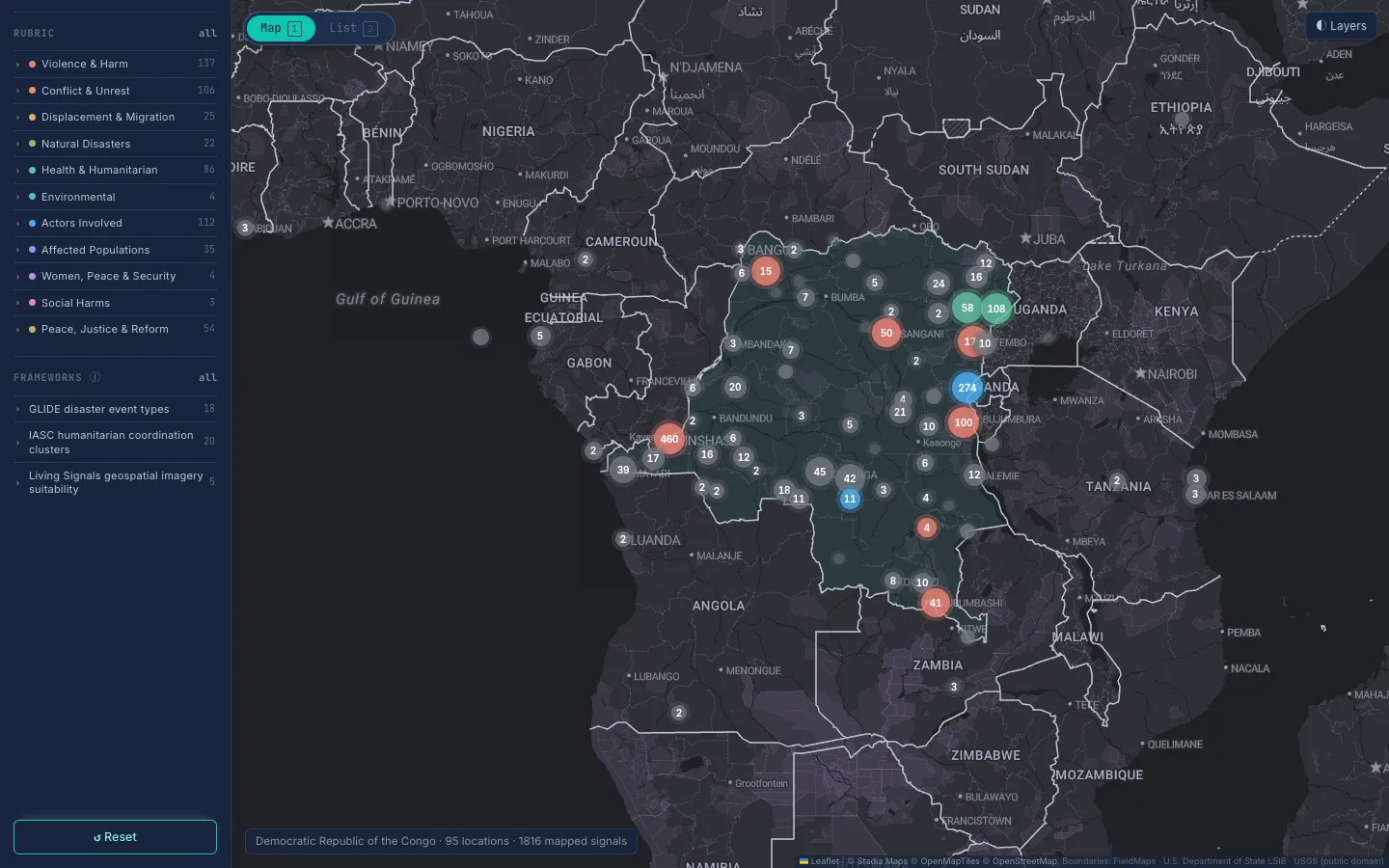
Example data: 3,253 Signals from our production pipeline for 15 Aug – 15 Sep 2026, with a hand-checked set open in full. Runs with no live connection. Satellite views carry their own attribution.
How It Works
From local reporting to answers you can trace.
We collect diverse sources
Local, national and international outlets in 25+ languages, read every day, with an emphasis on the ground reporting that web search and established datasets miss.
AI extracts structured claims
Each article becomes discrete factual claims, each with a place, a date, its source and the original-language quote.
Claims merge into Signals
Every outlet’s claims about one event merge into a single located, dated Signal, graded into eleven categories and coded to frameworks such as GLIDE and IASC. Selected Signals carry satellite views.
Explore it, or ask your AI tools
Work in the dashboard and the daily Brief, or connect Living Signals to Claude or ChatGPT through the MCP connector and API. Every answer traces back to its sources.
What Sets Living Signals Apart
The data behind decisions matters.
- —Favors mainstream news media, circulating content through SEO and algorithmic bias.
- —Elevates high-level insights that break news.
- —Weakly captures local reporting and on-the-ground accounts.
- —Thematic scope limited to a narrow band of security event types.
- —Often privileges high-intensity and violent armed conflicts.
- —Infrequently updated, with low spatial resolution.
- —Emphasis on events reaching certain visibility thresholds, at the expense of lower-intensity developments.
 Living Signals
- Updated daily from 2,200+ local, national and international sources in 25+ languages.
- Multi-source: every outlet that reported an event is merged into one Signal, so you see where accounts agree and where they differ.
- Located to the place the reporting names, often a town or village, not just a province.
- Wider by design: risks and opportunities, positive peace and systemic harms, coded to frameworks such as GLIDE and IASC.
- Geospatial enrichment (pilot): satellite views check reported fires, mining and hazards from orbit.
| Condition | Web search | Security datasets | Living Signals |
|---|---|---|---|
| Local & on-the-ground reporting | |||
| Non-mainstream sources, across languages | |||
| Every outlet on an event merged, with disagreements visible | |||
| Updated daily | |||
| Located to the town or village | |||
| Beyond high-intensity violence, including positive peace | |||
| Coded to humanitarian frameworks (GLIDE, IASC) | |||
| Satellite views of selected events (pilot) | |||
| Structured for AI research tools |
Our Approach
Capturing a wide net of data rather than starting with subjective definitions of what “counts.”
Terms like “humanitarian crisis” or “terrorism” are contested and defy definitional consensus across institutions. If we label events with these terms, we're imposing our interpretation. This isn't abstract: it holds political weight. Instead, we capture factual attributes that researchers combine however they want. Tagging signals with a range of keywords lets users customize their security typologies and practically monitor signals that don't fit squarely in one category, but span themes.
“Ethnic conflict”
- Risks to ethnic groups and marginalized populations
- Land competition
- Farmer-herder conflict
- Inter-communal peace process
Users define their own categories by combining our attributes. The data stays neutral; interpretation is preserved for the analyst.
What's at Stake
Taking care of data collection and synthesis so analysts can do the human-to-human work that matters.
Researchers & Analysts
Use raw signal data as evidence in reporting and for triangulation with other sources. Export Living Signals data and upload as a data layer in existing dashboards and models.
Strategists & Advisors
Compose concept notes and analytical products, ad hoc or routinely, grounded in how conditions are evolving on the ground.
Decision-Makers
Need quick, reliable briefs grounded in daily data when priorities shift.
Built to support analysts, not replace them, across international organizations, governments, and research institutions.
See It In Action
Start asking questions of greater complexity.
Living Signals connectorWhat do we know about the gold mine collapse on the Cameroon–CAR border in August? Where do the sources disagree?
Gold mine collapse at Zamboye / Zamboï, 18 August 2026
What happened
On 18 August a landslide buried miners at an artisanal gold site on the stream that forms the border near Garoua-Boulaï. Ten outlets from both countries reported it, in English and French.
Where accounts differ
The toll ranges from “at least 33” to “at least 49”. Cameroon’s government confirmed four Cameroonian dead; one Central African outlet reports thirteen among the 49.
From 16 claims by 10 outlets · GLIDE: technological disaster · each figure links to the claim it came from
Pilots and partners
How organisations use Living Signals

Risk monitoring
Analysts follow emerging risks day by day, including through the MCP connector.

Peace trends analysis
Studying local developments through the Positive Peace framework, where other datasets lack detail.

Gender-aware AI
Bringing humanitarian values and a gender lens to the data, from collection to analysis.
Want to run a case study with us?
We're developing case studies with partner organisations. Tell us about your team.